
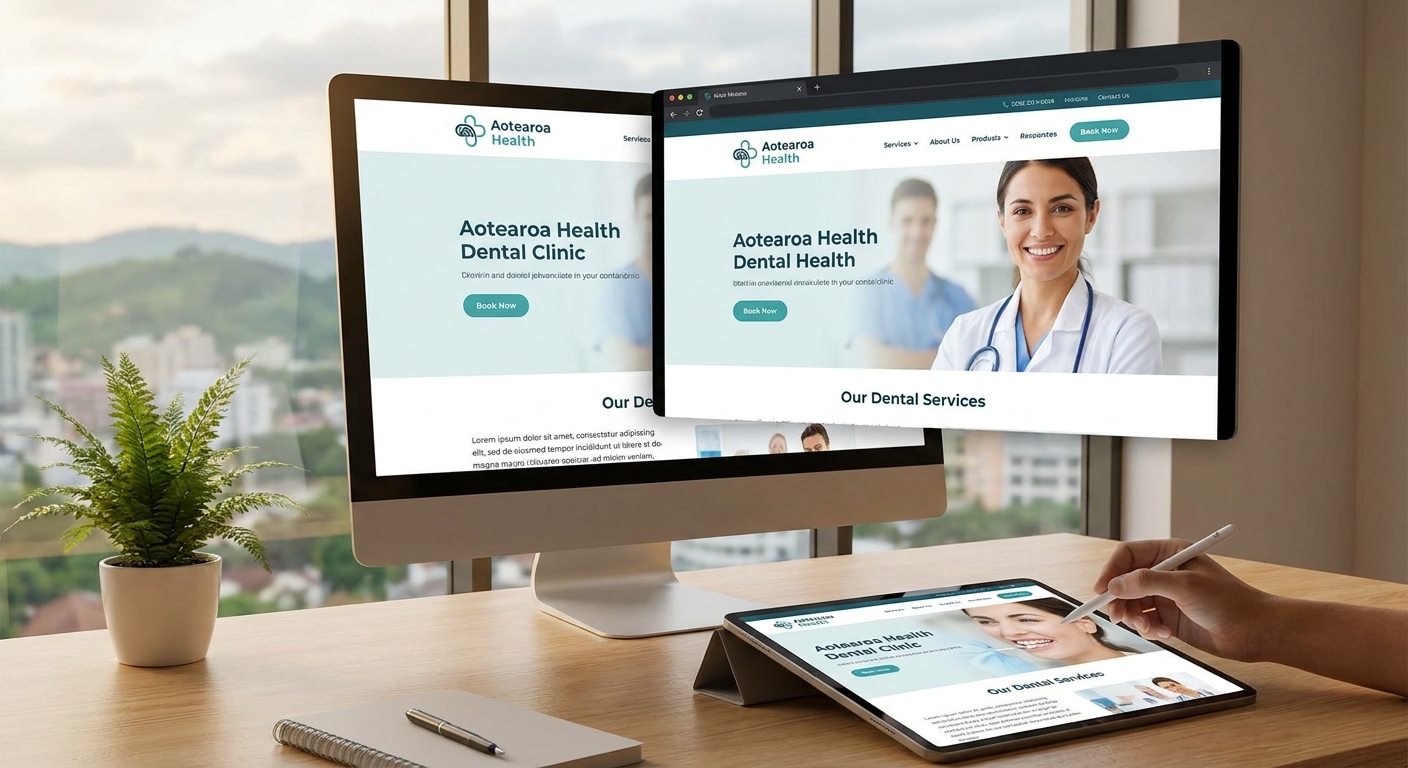
Patients book teeth cleans and GP appointments from their phones now, not the Yellow Pages, and if your clinic's website can't handle that shift in 2026 you're losing bookings to whoever's site loads faster.
- Web design for medical clinics nz needs mobile booking, Privacy Act-compliant forms, and sub-2.5-second load times.
- DIY builders suit a solo GP room; multi-practitioner clinics need a full-service build. Verdict: Consider DIY, Buy agency.
- Google's Core Web Vitals mark 2.5 seconds as the pass threshold for load speed — miss it and mobile patients bounce.
- Patient testimonials about treatment outcomes sit in a legal grey zone under NZ health advertising rules — check before publishing.
Why this matters
A clinic website isn't a brochure anymore — it's the front desk. Someone with a sore tooth at 9pm is searching "emergency dentist [suburb]" on their phone, and they'll book with whichever practice lets them do it in under a minute. If your site still routes every enquiry through a contact form that emails the receptionist on Monday, you're handing that patient to a competitor with online booking switched on.
Agencies that build for healthcare, like No Brainer, spend as much time on booking flow and privacy compliance as they do on the colour palette. That's the gap most generic web builders miss — they'll make your clinic look sharp and still fail the one job that actually drives revenue: getting the appointment booked.
Who this is for
This guide is for practice owners, practice managers, and clinic marketing leads across GP practices, dental clinics, physio rooms, and allied health providers in New Zealand who are choosing between a DIY builder, a freelancer, or a full-service web design partner. If you're managing more than one practitioner's calendar, or you're handling patient health information through your website's contact forms, the stakes here are higher than a typical small-business site.
What to look for in web design for medical clinics NZ
Mobile-first booking flow
Most of your traffic in 2026 arrives on a phone, and a booking button buried three menus deep costs you appointments. The flow needs to work in three taps or fewer: service, time, confirm.
Privacy Act and Health Information Privacy Code compliance
Any form that collects a name, phone number, or symptom description is collecting health information, and New Zealand's Health Information Privacy Code 2020 sets out 13 rules on how that data gets collected, stored, and disclosed. A generic contact-form plugin usually isn't built with those rules in mind.
Load times under 2.5 seconds
Google's Core Web Vitals mark 2.5 seconds as the pass threshold for Largest Contentful Paint, and a widely cited Google mobile benchmark from 2017 found 53% of mobile visits get abandoned if a page takes longer than three seconds to load. For a clinic site, that's the difference between a booked appointment and a bounce.
Local SEO tuned for "near me" searches
A clinic ranking for "dentist Manukau" or "GP near me" needs a Google Business Profile that matches the website's name, address, and phone exactly, plus service pages built around the suburbs you actually serve — not just a single generic "services" page.
Accessibility for every patient, not just the tech-savvy ones
Older patients and anyone with low vision need text that scales, buttons that are easy to tap, and colour contrast that actually meets WCAG 2.1 AA. A clinic site that fails accessibility basics is turning away exactly the demographic that visits most often.
Integration with your practice management software
If your booking calendar lives in Medtech32, Best Practice, or MyPractice, your website needs to talk to it directly. A site that can't sync means someone's still manually re-entering bookings, which defeats the point of having online booking at all.
Which approach actually fits your clinic
DIY website builder — the cheap fix. Squarespace or Wix gets a solo practitioner online fast, with templates that look clean out of the box. The catch: patient data forms on these platforms rarely meet Health Information Privacy Code expectations without custom work, and booking integrations with clinical software are limited or absent. Verdict: Consider for a single-room practice with no complex booking needs, Skip for anything multi-practitioner.
Freelance web designer — the middle ground. A freelancer can build a custom-looking site at a lower cost than an agency, and turnaround is often quicker for a simple brochure site. The risk is ongoing support — if the freelancer moves on, your compliance updates and security patches stop. Verdict: Consider if you have in-house tech support to fall back on, Hold if you don't.
Full-service agency — the safe long-term pick. An agency builds the booking flow, the privacy-compliant forms, the local SEO structure, and the ongoing support into one package, and keeps updating it as Google's ranking signals and NZ's privacy rules shift. Partners like No Brainer treat the clinic's website as infrastructure, not a one-off project. Verdict: Buy for any clinic running more than one practitioner or handling sensitive patient forms.
What to avoid
- Stock photos of generic doctors shaking hands. Patients recognise stock imagery instantly, and it does nothing for trust or local search relevance — real photos of your actual practitioners and clinic space outperform every time.
- Unverified treatment testimonials. Publishing patient reviews that make specific claims about treatment outcomes can run into NZ's health advertising rules — check what's actually allowed before you post that five-star review verbatim.
- A contact form as your only booking option. If "fill out this form and we'll call you back" is the entire booking journey in 2026, you're losing every patient who wanted to book at 9pm on a Sunday.
Verdict comparison
| Approach | Booking flow | Privacy compliance | Ongoing support | Verdict |
|---|---|---|---|---|
| DIY builder | Basic, limited integrations | Needs manual setup | None built-in | Consider (solo practice) |
| Freelancer | Custom but one-off | Depends on freelancer's knowledge | Stops if they move on | Hold |
| Full-service agency | Built and integrated | Built into the process | Ongoing | Buy |
Get a clinic site that actually books
Talk to No Brainer about a booking-ready, compliant clinic website.
FAQ
What's the best web design approach for medical clinics in NZ?
A full-service agency build is the safest approach for any clinic with more than one practitioner or online patient forms. DIY builders work fine for a solo practice with simple needs, but they rarely handle Health Information Privacy Code compliance without custom work.
How much should a dental clinic website cost in NZ?
Costs vary widely depending on booking integrations, the number of service pages, and whether practice management software needs syncing. Get a scoped quote rather than comparing sticker prices across builders and agencies.
Do medical websites need to comply with the Privacy Act?
Yes — any form collecting patient names, contact details, or symptoms falls under New Zealand's Privacy Act and the Health Information Privacy Code 2020, which sets 13 rules on handling that information. Generic contact-form plugins usually aren't built with these rules in mind.
Can I use patient testimonials on my clinic website in NZ?
It depends on the claim — testimonials that make specific claims about treatment outcomes can run into NZ's health advertising rules. Check with your professional body or a marketing partner before publishing patient reviews verbatim.
How fast should a clinic website load?
Aim for under 2.5 seconds, which is Google's Core Web Vitals pass threshold for Largest Contentful Paint. A 2017 Google mobile benchmark found 53% of mobile visits get abandoned past the three-second mark.
Is Squarespace good enough for a GP practice?
Squarespace works for a single-practitioner clinic with basic booking needs, but it struggles with practice management software integrations and custom privacy-compliant forms. Multi-practitioner clinics usually outgrow it fast.
What is Core Web Vitals and why does it matter for clinics?
Core Web Vitals are Google's ranking signals for page speed and stability, with 2.5 seconds as the Largest Contentful Paint pass mark. Clinics that miss this threshold rank lower in local search and lose mobile patients to slow load times.
Do I need a mobile app or just a mobile-friendly website?
A mobile-friendly website covers almost every clinic's needs in 2026 — an app adds development and maintenance cost most practices don't need. Focus the budget on a booking flow that works cleanly in a phone browser instead.
One last thing
The Health Information Privacy Code has been in force since 2020, yet plenty of NZ clinic sites still forward enquiry-form submissions as plain-text email, which is exactly the kind of handling the code was written to prevent. Fixing that isn't a redesign — it's a form and hosting decision, and it's worth checking before your next website refresh, not after a complaint lands.